Institutional accountability is a key issue in the public sector in developing countries, but it is not always a reality. Administrative effectiveness is not necessarily reflected in transparency, responsiveness, and citizen-oriented governance. Transformational leadership is found to be one of the elements that can facilitate institutional transformation in public sector organizations by stimulating innovation, strengthening organizational capacity, and fostering ethical administration practices. But empirical studies about the link between leadership transformation, quality of governance, and accountability outcomes in Bangladesh are still weak. This paper explores the contribution of transformational leadership-inspired public sector reforms in good governance and accountability of institutions in Bangladesh through a longitudinal secondary-data analysis of 2000-2024. The five dimensions on which the document-based Leadership Transformation Index (LTI) was created are civil service reform, digital governance, performance management, leadership development, and public-sector innovation. Governance quality was captured through the World Bank's Worldwide Governance indicators government effectiveness, regulatory quality, and rule of law and institutional accountability was operationalized using voice, accountability, and control of corruption indicators. Descriptive analysis, correlation analysis, principal component validation, and ordinary least squares (OLS) regression analysis are used in the study using Python-based statistical analysis methods. The results show that leadership transformation has a positive and significant relationship with governance quality, accounting for 70.1% of the variance in governance quality (R² = 0.701; p < 0.001). But the link between leadership transformation and governance quality and institutional accountability is not as straightforward, with 17.8% of the variance accounted for by the accountability model. The results indicate that administrative reform and the capacity to govern are not necessarily sufficient to bring about accountability that is mechanisms that are more effective. The study brings new insights to public administration literature by constructing a leadership-governance-accountability framework for the Bangladesh context and the significance of marrying transformational leadership and institutional accountability reforms.
Research ArticleGovernance and Public AdministrationIn progress
Transformational Leadership and Good Governance: Examining the Role of Public Sector Leaders in Strengthening Institutional Accountability in Bangladesh
Correspondence: antara.sarkerdu@gmail.com
Abstract
Keywords Transformational leadershipgood governanceInstitutional accountabilitypublic sector reformBangladeshGovernance indicatorsadministrative transformation
1. Introduction
Worldwide, public sector institutions are facing growing pressure to be more efficient, transparent, accountable, and responsive. Governments in developing countries often carry out administrative reforms to improve institutional performance, but institutional governance improvement needs more than just structural reforms and policy interventions. Leadership capacity, the organizational culture, and leadership's capacity to inspire action of the institutional actors towards common goals are key factors in the effectiveness of public sector transformation [1, 2]. Transformational leadership theory suggests that leaders may have the ability to lead change in the organization by articulating a shared vision, fostering innovation, intellectually stimulating employees, and promoting the ethical values in the institutions [3, 4]. Such factors are especially applicable to public administration systems that face complex institutional challenges and have to be reformed over a long period of time and need adaptive leadership.
The concept of good governance has emerged as a broad consensus approach towards assessing public sector performance. It is based on the following principles: effectiveness, transparency, accountability, participation, rule of law, and responsiveness [5]. Worldwide Governance Indicators (WGI) developed by the World Bank offer a broad-based approach that measures the quality of governance along six dimensions: government effectiveness, regulatory quality, rule of law, control of corruption, voice and accountability, and political stability [6]. Governance indicators offer good insights into institutional performance, but improving administrative capacity does not automatically ensure improved accountability mechanisms. There is a disconnect between capacity development of the state and the development of effective accountability systems in many developing countries [7].
Bangladesh is a significant case study to explore the connection between leadership change, governance enhancement, and institutional accountability. In the last twenty years, Bangladesh has been conducting multiple public sector modernization programs such as digital government transformation, public service innovation programs, performance management systems, and administrative capacity-building programs. These changes have helped to improve government effectiveness and systems for delivering services. But issues of accountability, transparency, and sustainability of governance within institutions are major challenges [8]. Previous research on governance in Bangladesh has mainly centered on administration reform, corruption control, institutional quality, and performance of development. Although these studies offer important perspectives on governance issues, the leadership processes and structures that facilitate or hinder institutional change have received less attention.
In the context of public sector reforms, transformational leadership is important, as it is needed to move from the traditional approaches that are resisted by the bureaucracy to innovations in the system and to create an organizational culture of accountability [9]. Thus, the link between the transformation of leadership and governance outcomes is an important field of inquiry. Transformational leaders can contribute to the quality of governance by enhancing administrative capacity, fostering the digital transformation, strengthening the system of performance monitoring, and facilitating innovation in public institutions. But it is an empirical issue whether these governance developments lead to better institutional accountability. Administrative efficiency can coexist with the constraints of accountability where transparency, citizen participation, and institutional checks are not yet adequate [10].
This study is an attempt to fill this research gap by studying the relationship between transformational leadership-oriented public sector transformation, governance quality, and institutional accountability in the context of Bangladesh. This study takes a new approach to measuring leadership in public sector transformation by creating a document-based Leadership Transformation Index (LTI), which provides a way to observe the public sector transformation initiatives that occurred over time. The index is linked to international, well-established governance indices to examine the long-term correlation of leadership change and institutional outcome. The study advances in three aspects. First, it introduces the study of transformational leadership into the public administration arena and looks at leadership as a tool of institutional transformation, not just as an individual behavioral phenomenon.
Second, it adds to the body of literature on governance by examining if administrative capacity improvement leads to accountable governance outcomes. Third, it offers empirical evidence from the context of a developing country, which is where the issue of public sector reform and governance is still quite topical.
The study addresses the following research questions:
RQ1: How has transformational leadership-oriented public sector transformation evolved in Bangladesh between 2000 and 2024?
RQ2: What relationship exists between leadership transformation and governance quality?
RQ3: Does improved governance quality contribute to stronger institutional accountability?
2. Literature Review
2.1 Transformational Leadership Theory and Public Sector Change
Burns introduced a new concept of leadership transformational leadership which involves bringing about changes in values, motivation, and commitment to the organization, as opposed to transactional leadership, which is based on exchanges between leaders and followers [1]. Building on this idea, Bass found four important components of transformational leadership: individualized consideration, inspirational motivation, intellectual stimulation, and idealized influence [2]. These dimensions account for the way in which leaders inspire followers to perform beyond the expected and make a difference in the organization. Transformational leadership is different from traditional administrative leadership that focuses on vision development, innovation, and organizational change in the long term. Transformational leaders work to change the culture of institutions and to inspire workers to contribute to the overall objectives of the organization [3].
This is especially so in the case of public organizations as government reforms often involve a change in administrative behavior, organizational norms, and service delivery approaches. Transformational leadership has been found to be positively related to organizational effectiveness, employee commitment, innovation, and change management capability [4]. Avolio, Walumbwa, and Weber stated that transformational leadership is still one of the most important leadership theories because of its ability to demonstrate the impact a leader has on an organization's outcomes through psychological and structural processes [4]. In a similar manner, the results of Judge and Piccolo's meta-analysis showed strong relationships between transformational leadership and leadership effectiveness and organizational performance [11]. Transformational leadership is also significant in the context of public administration, where government bodies function in intricate settings where bureaucracy, political pressures, and accountability requirements are present.
Managing public administration in an efficient, ethical, and citizen-friendly manner. Van Wart continually pointed out that public sector leadership demands an adaptive ability that incorporates managerial skills, ethical behavior, and dedication to public values [12].
2.2 Transformational Leadership and Public Sector Reform
For public sector transformation to happen, leaders are needed who can manage institutional change and overcome resistance to reform. Leadership commitment was one of the important factors that affect successful changes in public institutions found by Fernandez and Rainey [13]. Where leadership is weak, the reforms in administration may in fact not amount to much action in terms of organizational change but rather symbolic policies. There are various ways in which public sector leaders shape outcomes of reforms. They first determine strategic direction through communicating reform goals and developing shared institutional visions. Second, they promote innovation by enabling experimentation and new ways of providing public services. Thirdly, they enhance organizational learning and build employee capabilities and knowledge systems [9].
One of the most prominent examples of leadership-driven public sector change is digital transformation. But digital government projects need institutions that are able to coordinate a number of actors, redesign administrative procedures, and encourage citizens to use government services. Research on public sector innovation indicates that it is important to have the commitment of leadership to make digital transformation and institutional modernization work [14]. In Bangladesh, examples like Digital Bangladesh and the following public service innovation programs are reflections of the significance of administrative transformation with leadership. The purpose of these reforms was to make public services more accessible, make government more efficient, and stimulate innovation in public service delivery.
But there is a need for more research to see how these innovations have contributed to improving accountability mechanisms.
2.3 Good Governance and Institutional Accountability
The concept of good governance is a key concept in public administration and development studies. It highlights that institutions must be transparent, accountable, participatory, and rule-governed in addition to having administrative capacity [5]. Thus, the quality of governance can be understood as the capacity of institutions to design and execute good policies and to do so in a way that is legitimate and trusted by the public. One of the most commonly used tools to measure governance performance is the World Bank Governance Indicators. The governance indicators used here were created by Kaufmann, Kraay, and Mastruzzi, which measure the performance of government institutions in various areas such as government effectiveness, regulatory quality, rule of law, control of corruption, and voice and accountability [6].
These indicators have been broadly used in comparative governance studies. Institutional accountability is the process used by public institutions to explain themselves, take responsibility, and react to the people involved. Bovens defined accountability as a relationship that calls actors to account, which means that these actors are expected to give reasons and justification for their actions to another actor or institution [15]. Accountability is a key feature of democratic governance, which is necessary to prevent misuse of authority and increase confidence in governance mechanisms. But capacities and accountability in governance do not necessarily go hand in hand. The institutions can improve administration and efficiency while being weak in terms of transparency, citizen participation, and control mechanisms.
Fukuyama argued that good governance is a result of balancing state capacity with institutional power that is constrained by mechanisms [16]. Hence, the need for understanding the relationship between governance improvement and accountability is still crucial.
2.4 Governance and Leadership Challenges in Bangladesh
In the past 20 years, Bangladesh has made tremendous progress in administrative capacity, economic development,, and public service provision. Digital transformation, performance management, and administrative modernization are the priorities of public sector reforms. However, governance issues persist in the field of institutional accountability, corruption control, and transparency. Past research has emphasized that the governance performance in Bangladesh is mixed on the one hand, gains in state capacity, and on the other, persistent accountability problems. This means that institutional effectiveness is not enough to set up comprehensive governance quality. A leadership-based view offers an opening to comprehend these dynamics. While transformational leadership could be a possible explanation for how reform-oriented leaders bring about institutional improvements, outcomes of accountability require a range of institutional arrangements, oversight mechanisms, and participatory structures. In this regard, the study incorporated transformational leadership theory with a governance and accountability framework in order to find out the impact of leadership-oriented transformation on institutional outcomes in Bangladesh.
3. Research Framework and Methodology
3.1 Research Framework and Hypothesis Development
This study aims to create a research model to investigate the impact of transformational leadership-oriented public sector transformation on governance quality and institutional accountability in Bangladesh. The framework is based on a mix of three theoretical approaches: transformational leadership theory, good governance theory, and institutional accountability theory. Transformational leadership theory provides an understanding of how leaders can bring about organizational change by developing a vision, promoting innovation, stimulating intellectually, and enhancing capacities [1, 2]. The transformational leadership differs from leadership as a process because it is addressing long-term institutional improvement, a process that involves organizational learning, adoption of reform, and a commitment to a common set of goals [3, 4].
In the public sector domain, transformational leadership becomes especially relevant in addressing the potential bureaucratic complexity, resistance to change, and accountability issues that can arise in governmental institutions. Administrative reform, digital transformation, performance-based management, and innovation are all leadership strategies that can help to increase the capacity of institutions and improve governance performance [9, 12]. From this view, the study considers transformational leadership as an institutional transformation mechanism but not just an individual leadership behavior. Notional leadership change transformation of public officials cannot be measured in the available public documents, so this study creates a document-based Leadership Transformation Index (LTI) to capture transformation initiatives that are observable in the public sector.
The study suggests that leadership change enhances governance quality through enhancing administrative effectiveness, regulatory capacity, and institutional performance. Moreover, through better governance, it is assumed that institutional accountability mechanisms will be strengthened, with better transparency, corruption control, and institutional responsibility.
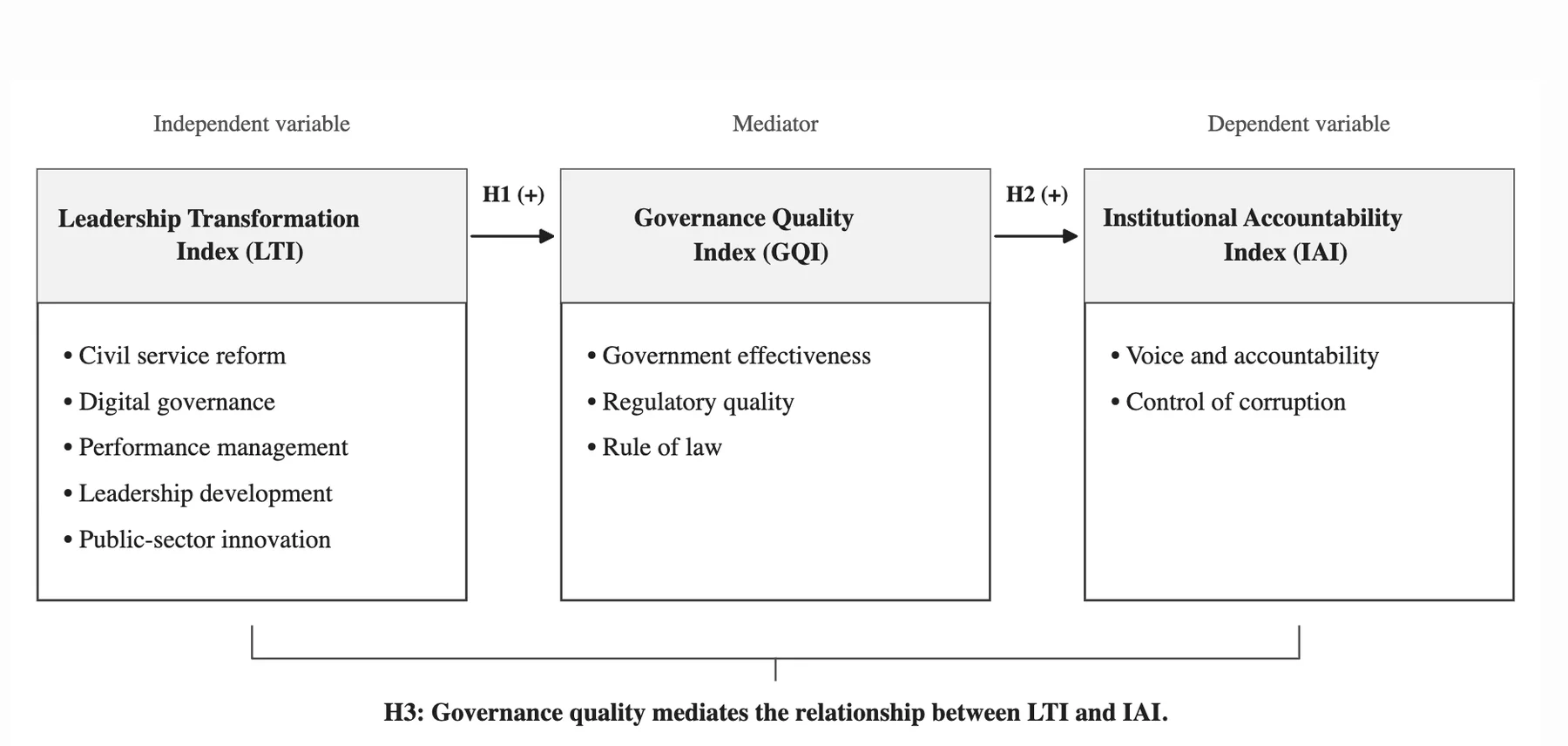
Figure 1 illustrates the theoretical relationship among transformational leadership-oriented public sector transformation, governance quality, and institutional accountability. The framework proposes that leadership transformation enhances governance quality, which subsequently contributes to institutional accountability. The model is developed based on transformational leadership theory [1, 2] and governance literature [5, 6].
Transformational Leadership and Governance Quality
There is a need for leadership in public sector transformation that will generate institutional change and innovation and build administrative capacity. Transformational leadership affects the outcome of the organization by developing vision, motivating employees, fostering innovation, and enabling implementation of change [3, 4]. Past research shows that transformational leadership can lead to an effective organization, successful change management, and an increase in the adaptability of the institution and employee commitment [9, 11]. Reforms that focus on improving leadership in government organizations can help improve the delivery of services, administrative procedures, and governance capabilities.
Therefore, this study proposes:
H1: Transformational leadership-oriented public sector transformation positively influences governance quality in Bangladesh.
Leadership Transformation Index → Governance Quality Index
Governance Quality and Institutional Accountability
Effective, transparent, rule-based, and accountable institutions are needed for good governance. The World Bank governance framework highlights that government effectiveness, regulatory quality, and the rule of law are key foundations to institutional performance [6]. However, simply having institutional capacity does not necessarily guarantee accountability. Other mechanisms such as transparency, citizen participation, corruption control, and institutional oversight are essential for accountability [15, 16].
H2: Governance quality positively influences institutional accountability in Bangladesh.
Governance Quality Index → Institutional Accountability Index
Transformational Leadership, Governance Quality, and Accountability
Transformational leadership can help with accountability indirectly by establishing governance conditions that nurture responsible administration. Performance monitoring, ethical practices, institutional innovation, and administrative modernization all help reform-oriented leaders to strengthen accountability.
H3: Governance quality mediates the relationship between transformational leadership-oriented transformation and institutional accountability.
Leadership Transformation → Governance Quality → Institutional Accountability
3.2 Research Design
The study is of a longitudinal quantitative nature to analyze the correlation of transformational leadership-oriented public sector transformation, governance quality, and institutional accountability in Bangladesh. The analysis is conducted with the time span 2000–2024 to support analysis of long-term patterns of institutional transformation. The secondary-data approach is used since governance indicators offer internationally comparable measures of institutional performance over time.
The empirical analysis consists of three major stages:
Development of the Leadership Transformation Index (LTI)
Construction of Governance Quality Index (GQI)
Measurement of Institutional Accountability Index (IAI)
The overall analytical model is
LTI → GQI → IAI
3.3 Data Sources and Variable Measurement
3.3.1 Leadership Transformation Index
There are no direct measures of transformational leadership behaviors of public-sector leaders in existing international governance datasets. Thus, this study constructs a Leadership Transformation Index on public sector reform efforts that can be observed. The index captures five dimensions:
| Dimension | Measurement Concept |
|---|---|
| Civil Service Reform | Administrative modernization and institutional reform |
| Digital Governance | Digital public service transformation |
| Performance Management | Performance-based management systems |
| Leadership Development | Public-sector leadership and capacity development |
| Innovation Reform | Public service innovation initiatives |
Each dimension is coded using a three-point scale:
0 = No significant transformation
1 = Moderate transformation
2 = Major transformation
The Leadership Transformation Index is calculated as: Higher values represent stronger transformation intensity.
(1)
3.3.2 Governance Quality Index
Governance quality is measured using the World Bank Worldwide Governance Indicators (WGI) dataset [6].
The study uses three governance dimensions:
Government Effectiveness
Regulatory Quality
Rule of Law
These indicators represent administrative capacity, policy implementation quality, and institutional reliability.
The Governance Quality Index is calculated as:
(2)
3.3.3 Institutional Accountability Index
Institutional accountability is measured using two governance indicators:
Voice and Accountability
Control of Corruption
These indicators represent institutional responsiveness, transparency, and integrity mechanisms.
The index formula is:
(3)
Table 1. Description of Variables and Data Sources
| Variable | Type | Indicators | Source |
|---|---|---|---|
| Leadership Transformation Index | Independent Variable | Civil service reform, digital governance, performance management, leadership development, innovation reform | Government reform documents |
| Governance Quality Index | Mediator | Government effectiveness, regulatory quality, rule of law | World Bank WGI |
| Institutional Accountability Index | Dependent Variable | Voice and accountability, control of corruption | World Bank WGI |
Table 1 presents the operational definitions of all study variables. Governance indicators are adapted from the World Bank Worldwide Governance Indicators framework [6], while leadership transformation is measured through document-based institutional reform indicators.
3.4 Statistical Analysis
All statistical analyses were performed using Python-based analytical tools, including Pandas, NumPy, Statsmodels, Scikit-learn, and Matplotlib.
The following analytical procedures were applied.
Descriptive Statistics
Descriptive statistics were calculated to summarize the distribution of study variables, including:
Mean
Standard deviation
Minimum value
Maximum value
Table 2. Descriptive Statistics of Study Variables
| Variable | Mean | Standard Deviation | Minimum |
|---|---|---|---|
| Leadership Transformation Index | 0.558 | 0.373 | 0.000 |
| Governance Quality Index | 41.785 | 1.698 | 37.818 |
| Institutional Accountability Index | 39.087 | 2.824 | 35.122 |
Table 2. summarizes the statistical characteristics of the main variables used in the empirical analysis.
Correlation Analysis
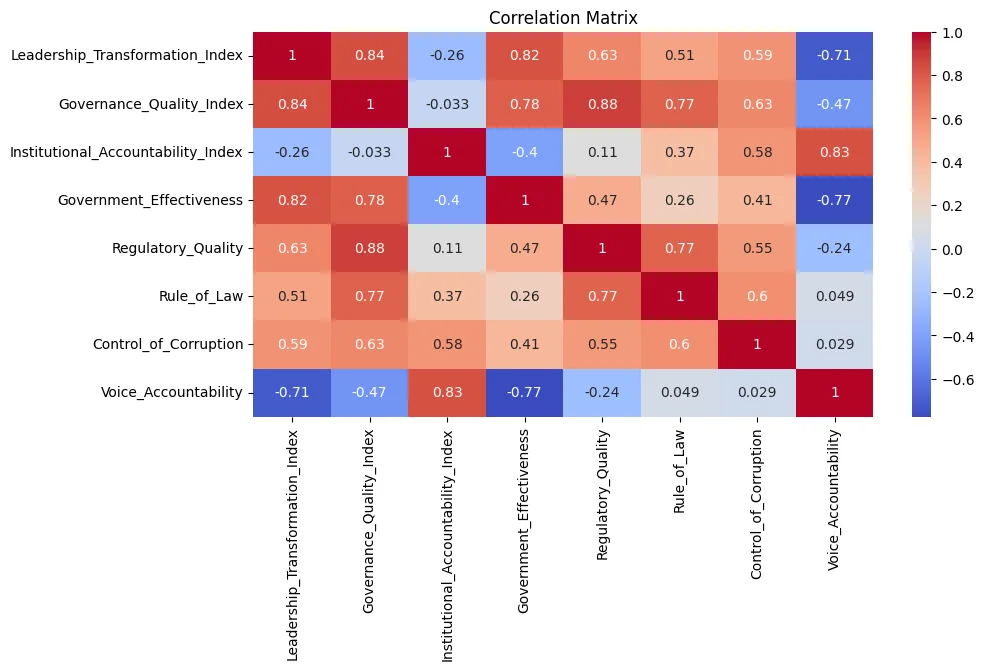
Pearson correlation analysis was conducted to examine relationships among:
Leadership Transformation Index
Governance Quality Index
Institutional Accountability Index
Correlation analysis provides initial evidence regarding the direction and strength of relationships among study constructs.
Principal Component Analysis
Principal Component Analysis (PCA) was applied to evaluate whether governance indicators represent a common institutional quality construct. PCA is commonly used in governance research to construct composite indicators from multiple correlated institutional measures.
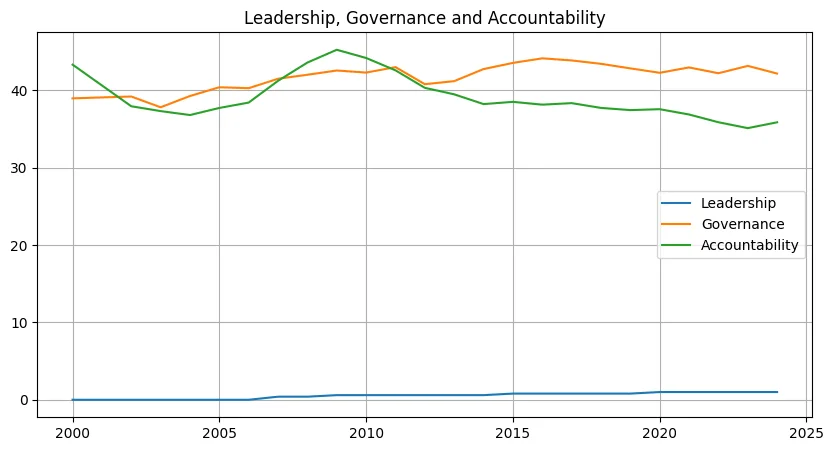
Figure 3 demonstrates the contribution of governance indicators to the overall governance quality construct and supports the construction of the Governance Quality Index.
Two regression models were estimated to test the hypotheses.
Model 1: Leadership Transformation and Governance Quality
This model tests H1:
(4)
Where:
GQI = Governance Quality Index
LTI = Leadership Transformation Index
A significant positive coefficient for LTI supports H1.
Model 2: Leadership Transformation, Governance Quality, and Accountability
This model tests H2 and H3:
(5)
Where:
IAI = Institutional Accountability Index
LTI = Leadership Transformation Index
GQI = Governance Quality Index
Table 3. Regression Results: Leadership Transformation and Governance Quality
| Variable | Coefficient | Std. Error | t-value | p-value |
|---|---|---|---|---|
| Leadership Transformation Index | 3.8125 | 0.531 | 7.181 | <0.001 |
| Constant | 39.6565 | 0.354 | 111.967 | <0.001 |
Table 3 presents the regression results examining whether leadership transformation-oriented reforms influence governance quality.
5. Results
5.1 Descriptive Statistics
Table 4 provides the descriptive statistics of the key variables of the study for Bangladesh in 2000-2024. The Leadership Transformation Index (LTI) shows a steady growth across the study period, where public sector transformation initiatives, such as administrative reform, digital governance, performance management, and innovation-oriented programs, have been growing over the years. The Governance Quality Index (GQI), which combines government effectiveness, regulatory quality, and rule of law indicators, depicts a more fairly steady upward trend. The mean value of the Governance Quality Index shows a moderate level of improvement in the institutional capacity of Bangladesh throughout the period of study. The Institutional Accountability Index (IAI), which is based on the voice and accountability and control of corruption indicators, displays a larger range of variation. This implies that as administrative capability has improved, so have not necessarily accountability mechanisms.
Table 4. Descriptive Statistics of Study Variables
| Variable | Mean | Standard Deviation | Minimum | Maximum |
|---|---|---|---|---|
| Leadership Transformation Index | 0.558 | 0.373 | 0.00 | 1.00 |
| Government Effectiveness | 44.082 | 2.623 | 38.717 | 48.192 |
| Regulatory Quality | 40.490 | 1.858 | 36.089 | 43.143 |
| Rule of Law | 40.783 | 1.825 | 36.697 | 44.920 |
| Control of Corruption | 30.001 | 3.126 | 23.420 | 35.319 |
| Voice and Accountability | 48.174 | 4.614 | 40.844 | 55.324 |
| Governance Quality Index | 41.785 | 1.698 | 37.818 | 44.146 |
| Institutional Accountability Index | 39.087 | 2.824 | 35.122 | 45.254 |
The descriptive statistics indicate that Bangladesh experienced gradual improvement in governance capacity, while accountability-related indicators remained more volatile. Governance indicators were obtained from the World Bank Worldwide Governance Indicators framework [6].
5.2 Trend Analysis of Leadership Transformation
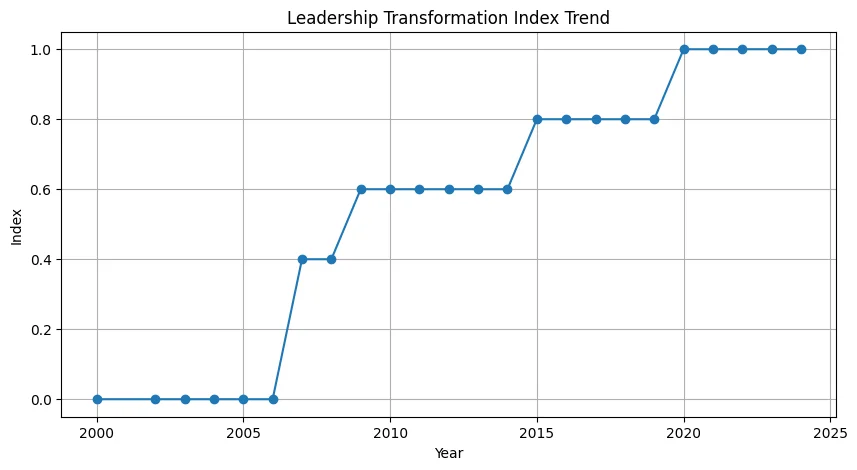
The Leadership Transformation Index shows a steady increase over the course of the study. The relatively limited transformation phase of the early 2000s is still dominated by traditional administrative structures and low-level digital integration. But since the public sector was modernized with large-scale initiatives, the intensity of the transformation rose. The rise since 2008–2009 is in sync with the growth of the digital governance efforts and the Digital Bangladesh agenda. Later changes are indicative of the implementation of performance management systems, public service innovation campaigns, and institutional strengthening projects. The trend reinforces an argument that transformational leadership is not just about the actions of individual leaders but can also be observed in the long-term institutional change processes. The document-based Leadership Transformation Index depicts the leadership transformation-oriented changes in Bangladesh from 2000 to 2024 (Figure 4).
5.3 Governance Quality Trends
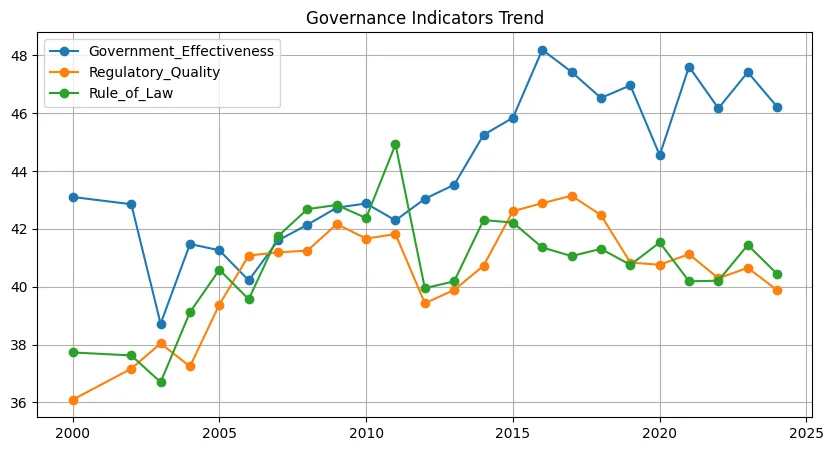
Governance indicators show steady improvement of Bangladesh's administrative capacity. Government effectiveness is the area with the most improvement, which may indicate improvements in public service delivery and administrative implementation. Moderate improvement in the implementation capacity of policies as regulatory quality is relatively stable. The rule of law shows signs of improvement, albeit beset with institutional issues. These findings suggest that although progress has been made in administrative governance in Bangladesh, the progress is incremental and not transformative. The findings align with literature on governance, which indicates that the institutional capacity development is a gradual process and dependent on administrative reforms, political institutions, and organizational capability [6,16].
5.4 Accountability Trends
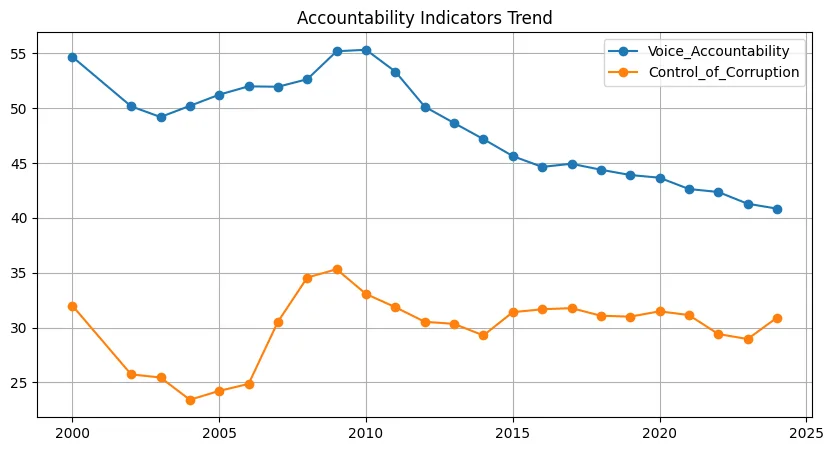
The accountability indicators show a more complicated picture than the governance capacity indicators. There is some improvement over the study period for control of corruption, but there is more variation over the study period for voice and accountability. This indicates that gains in administrative effectiveness do not necessarily lead to gains in participatory accountability mechanisms. The results confirm earlier governance studies that found that state capacity and state accountability are two related but distinguishable institutional dimensions [15, 16]. Figure 6 shows changes in accountability indicators, highlighting the distinction between accountability outcomes and improvements in administrative performance.
5.5 Governance Quality and Accountability Relationship
The regression results on the relationship between governance quality and institutional accountability suggest that enhancing governance capacity is not necessarily sufficient for improving institutional accountability outcomes. While governance quality is an indicator of institutional effectiveness, accountability needs other mechanisms, such as transparency, citizen participation, oversight structures, and ethical practices of administration. This result provides a reminder of the need to take into account leadership and institutional culture in assessments of governance outcomes.
5.6 Correlation Analysis
The correlation matrix shows good relationships between the governance dimensions. In order to verify the internal consistency of the constructed governance measure, positive relationships with the Governance Quality Index are observed for government effectiveness, regulatory quality and rule of law.
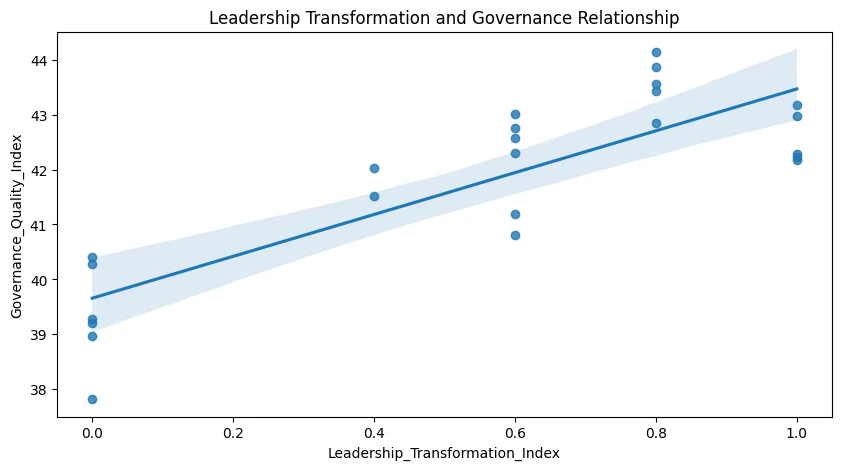
The results of the Leadership Transformation Index confirm a positive relationship with governance quality, in keeping with H1. Nonetheless, the connection between governance quality and accountability is comparatively weak, pointing to the fact that the capacity of administration is not the only factor to explain the improvement in accountability.
5.7 Regression Results
Model 1: Leadership Transformation and Governance Quality
The first regression model evaluates whether leadership transformation-oriented reforms influence governance quality.
The results show:
R² = 0.701
Adjusted R² = 0.687
Leadership Transformation coefficient = 3.8125 p-value < 0.001
The model explains approximately 70.1% of the variation in governance quality.
The positive and statistically significant relationship supports H1.
Table 3. Regression Results: Leadership Transformation and Governance Quality
| Variable | Coefficient | p-value | Interpretation |
|---|---|---|---|
| Leadership Transformation Index | 3.8125 | <0.001 | Positive significant effect |
| Constant | 39.657 | <0.001 | Baseline governance level |
Table 3 presents the estimated effect of leadership transformation-oriented reforms on governance quality. The significant positive coefficient supports the argument that transformational public sector reforms contribute to improved governance capacity.
Model 2: Leadership Transformation, Governance Quality, and Accountability
The second regression model examines whether leadership transformation and governance quality explain institutional accountability outcomes.
The model results are:
R² = 0.178
Adjusted R² = 0.100
Leadership Transformation Index:
β = -5.8275 p = 0.045
Governance Quality Index:
β = 1.0159 p = 0.106
The results indicate that the combined model explains 17.8% of accountability variation.
The negative coefficient of leadership transformation after controlling for governance quality suggests a complex relationship. This does not imply that leadership transformation reduces accountability. Rather, it indicates that rapid administrative transformation may occur faster than the development of accountability institutions.
Table 4. Regression Results: Leadership Transformation, Governance Quality, and Accountability
| Variable | Coefficient | p-value |
|---|---|---|
| Leadership Transformation Index | -5.8275 | 0.045 |
| Governance Quality Index | 1.0159 | 0.106 |
| Constant | 4.216 | 0.830 |
Table 4 examines whether leadership transformation and governance quality predict institutional accountability. The results indicate that governance capacity improvements require complementary accountability mechanisms to generate stronger institutional responsibility.
6. Discussion
This study examined the relationship between transformational leadership-oriented public sector transformation, governance quality, and institutional accountability in Bangladesh between 2000 and 2024. The findings provide three important insights. First, leadership transformation is strongly associated with governance improvement. The significant relationship between LTI and GQI supports transformational leadership theory, which argues that leaders influence organizational outcomes by promoting innovation, reform implementation, and institutional learning [1,2]. In Bangladesh, administrative modernization initiatives, digital governance programs, and performance management systems appear to have contributed to improvements in governance capacity. Second, the study demonstrates that governance improvement does not automatically translate into accountability improvement. While governance quality increased over the study period, accountability indicators showed greater instability. This supports the argument that institutional effectiveness and accountability represent separate dimensions of governance [15, 16]. Third, the results highlight the importance of considering institutional context. Transformational leadership may successfully improve administrative capacity; however, accountability requires additional structures such as transparency mechanisms, oversight institutions, citizen participation, and ethical governance practices. The findings contribute to public administration literature by showing that leadership transformation can serve as an important driver of governance improvement but should be integrated with accountability-oriented institutional reforms.
7. Limitations and Future Research
First, the Leadership Transformation Index is not an individual-level leadership survey but rather a proxy measure in the form of a document. Future research can be conducted to reinforce the results by applying validated transformational leadership instruments, for example, the Multifactor Leadership Questionnaire (MLQ), in order to gather survey data. Second, the study is limited to Bangladesh, which restricts its generalizability. The use of multiple developing countries in comparative studies might give more general insights. Third, the study relies on longitudinal governance indicators, and future research could include institutional-level data from ministries, government agencies, or local governments. Future studies should integrate survey-based measures of leadership with measures of governance to build a larger, more causal understanding of the leadership-governance relationship.
9. Conclusion
This study aimed to understand the role of transformational leadership-oriented public sector transformation in improving governance quality and institutional accountability in Bangladesh. The results show that there is a strong link between leadership transformation and enhancing the governance capacity. The administrative modernization, digital transformation, performance management, and innovation in the public sector have resulted in improved governance outcomes. The results also show, however, that the improvement of governance does not automatically lead to an improvement of accountability. There is a need for more mechanisms in the area of transparency, citizen involvement, ethical governance, and monitoring for institutional accountability. The study makes a contribution towards governance and public administration literature, as it shows that transformational leadership can be interpreted as a leadership approach as well as a mechanism of institutional transformation. Sustainable improvement of governance is needed in Bangladesh and other developing nations, and that can't be done without having efficient institutions but also accountability mechanisms from the leadership.
References
- Burns JM. Leadership. New York: Harper & Row; 1978. Bass BM. Leadership and Performance Beyond Expectations. New York: Free Press; 1985. Bass BM, Avolio BJ. Transformational leadership and organizational culture. Public Administration Quarterly. 1993;17(1):112–121. Avolio BJ, Bass BM, Jung DI. Re-examining the components of transformational and transactional leadership using the Multifactor Leadership Questionnaire. Journal of Occupational and Organizational Psychology. 1999;72(4):441–462. https://doi.org/10.1348/096317999166789 Avolio BJ, Walumbwa FO, Weber TJ. Leadership: Current theories, research, and future directions. Annual Review of Psychology. 2009;60:421–449. https://doi.org/10.1146/annurev.psych.60.110707.163621 Kaufmann D, Kraay A, Mastruzzi M. Governance matters VIII: Aggregate and individual governance indicators, 1996–2008. World Bank Policy Research Working Paper. 2009;4978. https://doi.org/10.1596/1813-9450-4978 Kaufmann D, Kraay A, Mastruzzi M. The worldwide governance indicators: Methodology and analytical issues. World Bank Policy Research Working Paper. 2010;5430. https://doi.org/10.1596/1813-9450-5430 Fukuyama F. What is governance? Governance. 2013;26(3):347–368. https://doi.org/10.1111/gove.12035 Fernandez S, Rainey HG. Managing successful organizational change in the public sector. Public Administration Review. 2006;66(2):168–176. https://doi.org/10.1111/j.1540-6210.2006.00570.x Wright BE, Moynihan DP, Pandey SK. Pulling the levers: Transformational leadership, public service motivation, and mission valence. Public Administration Review. 2012;72(2):206–215. https://doi.org/10.1111/j.1540-6210.2011.02496.x Judge TA, Piccolo RF. Transformational and transactional leadership: A meta-analytic test of their relative validity. Journal of Applied Psychology. 2004;89(5):755–768. https://doi.org/10.1037/0021-9010.89.5.755 Van Wart M. Dynamics of leadership in public service: Theory and practice. Public Administration Review. 2003;63(5):531–540. https://doi.org/10.1111/1540-6210.00322 Fernandez S, Pitts DW. Understanding employee motivation to innovate: Evidence from public employees. Public Performance & Management Review. 2011;34(4):548–568. https://doi.org/10.2753/PMR1530-9576340405 Mergel I. Digital transformation of the public sector: Challenges and opportunities. Public Management Review. 2019;21(6):843–854. https://doi.org/10.1080/14719037.2018.1473471 Bovens M. Analysing and assessing accountability: A conceptual framework. European Law Journal. 2007;13(4):447–468. https://doi.org/10.1111/j.1468-0386.2007.00378.x Rothstein B, Teorell J. What is quality of government? A theory of impartial government institutions. Governance. 2008;21(2):165–190. https://doi.org/10.1111/j.1468-0491.2008.00391.x Grindle MS. Good governance: The inflation of an idea. Planning Theory. 2004;2(2):103–117. https://doi.org/10.1177/1473095204003002002 Grindle MS. Good enough governance revisited. Development Policy Review. 2007;25(5):553–574. https://doi.org/10.1111/j.1467-7679.2007.00385.x Hood C. The new public management in the 1980s: Variations on a theme. Accounting, Organizations and Society. 1995;20(2–3):93–109. https://doi.org/10.1016/0361-3682(93)E0001-W Pollitt C, Bouckaert G. Public Management Reform: A Comparative Analysis. Oxford: Oxford University Press; 2017. North DC. Institutions, Institutional Change and Economic Performance. Cambridge: Cambridge University Press; 1990. Evans P, Rauch JE. Bureaucracy and growth: A cross-national analysis of the effects of Weberian state structures. American Sociological Review. 1999;64(5):748–765. https://doi.org/10.2307/2657374 La Porta R, Lopez-de-Silanes F, Shleifer A, Vishny RW. The quality of government. Journal of Law, Economics, and Organization. 1999;15(1):222–279. https://doi.org/10.1093/jleo/15.1.222 Acemoglu D, Robinson JA. Why Nations Fail: The Origins of Power, Prosperity, and Poverty. New York: Crown Publishers; 2012. Behn RD. Rethinking Democratic Accountability. Washington, DC: Brookings Institution Press; 2001. Siddiquee NA. Public administration in Bangladesh: Challenges and prospects. Asian Journal of Political Science. 2010;18(1):1–20. Sobhan R. Governance and development issues in Bangladesh. The Bangladesh Development Studies. 1998. World Bank. Worldwide Governance Indicators Dataset. Washington, DC: World Bank; 2024. Available from: https://info.worldbank.org/governance/wgi/ United Nations Development Programme (UNDP). Governance for Sustainable Human Development. New York: UNDP; 1997. Available from: https://www.undp.org/ Organisation for Economic Co-operation and Development (OECD). Public Sector Innovation and Digital Government Transformation. Paris: OECD Publishing; 2020. https://doi.org/10.1787/3b2f3d9a-en
CITE THIS ARTICLE
Sarker, A. (2026). Transformational Leadership and Good Governance: Examining the Role of Public Sector Leaders in Strengthening Institutional Accountability in Bangladesh. https://www.researchbyantara.com/article/6442970e-b804-4d75-b16a-856aab3ee55d
A. Sarker, “Transformational Leadership and Good Governance: Examining the Role of Public Sector Leaders in Strengthening Institutional Accountability in Bangladesh,” 2026. [Online]. Available: https://www.researchbyantara.com/article/6442970e-b804-4d75-b16a-856aab3ee55d
Sarker, A. (2026) ‘Transformational Leadership and Good Governance: Examining the Role of Public Sector Leaders in Strengthening Institutional Accountability in Bangladesh’. Available at: https://www.researchbyantara.com/article/6442970e-b804-4d75-b16a-856aab3ee55d
Sarker, Antara. “Transformational Leadership and Good Governance: Examining the Role of Public Sector Leaders in Strengthening Institutional Accountability in Bangladesh.” 2026, https://www.researchbyantara.com/article/6442970e-b804-4d75-b16a-856aab3ee55d.
Antara Sarker. “Transformational Leadership and Good Governance: Examining the Role of Public Sector Leaders in Strengthening Institutional Accountability in Bangladesh.” (2026). https://www.researchbyantara.com/article/6442970e-b804-4d75-b16a-856aab3ee55d.
Sarker A. Transformational Leadership and Good Governance: Examining the Role of Public Sector Leaders in Strengthening Institutional Accountability in Bangladesh. 2026. https://www.researchbyantara.com/article/6442970e-b804-4d75-b16a-856aab3ee55d
@misc{article_6442970eb8044d75b16a856aab3ee55d,
  title = {Transformational Leadership and Good Governance: Examining the Role of Public Sector Leaders in Strengthening Institutional Accountability in Bangladesh},
  author = {Antara Sarker},
  year = {2026},
  url = {https://www.researchbyantara.com/article/6442970e-b804-4d75-b16a-856aab3ee55d},
}
TY - GEN AU - Antara Sarker TI - Transformational Leadership and Good Governance: Examining the Role of Public Sector Leaders in Strengthening Institutional Accountability in Bangladesh PY - 2026 UR - https://www.researchbyantara.com/article/6442970e-b804-4d75-b16a-856aab3ee55d ER -